DogeThrift · Spending Guide
Dogecoin ATMs: How to Find One, and Why Cashing Out Is the Hard Part
Searching for a Dogecoin ATM gets you thousands of results and almost none of them do what you want. The machines are everywhere, and the overwhelming majority sell DOGE for cash rather than buying it. Getting physical money out of Dogecoin in person is a different product with a different operator, lower fees, and a 2,000 dollar daily ceiling. Worth knowing before you drive anywhere.
The short answer
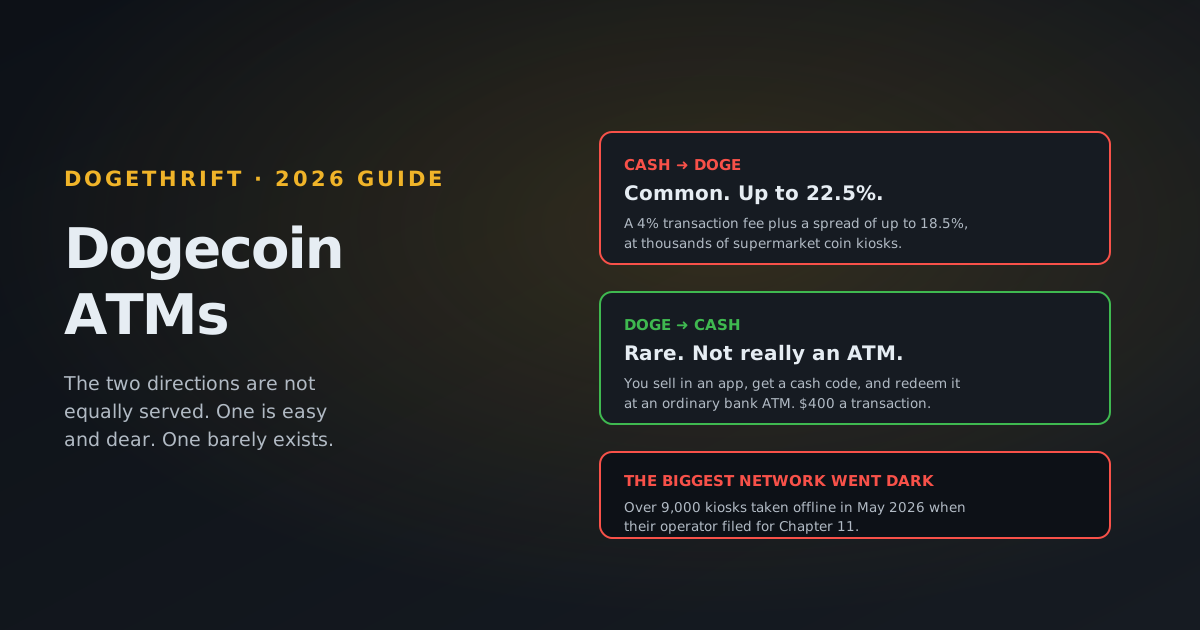
If you want to buy Dogecoin with cash, walk into a supermarket. Coinstar kiosks carry Dogecoin among more than 25 cryptocurrencies, and there are thousands of them. You will pay a 4 percent transaction fee plus a spread of up to 18.5 percent, which is a genuinely bad price and the reason we are not going to pretend otherwise.
If you want to turn Dogecoin into banknotes, the working route is Coinme's ReadyCode network. You sell inside the app, the app issues a cash code, and you redeem that code at an ordinary ATM in a grocery or pharmacy. Over 20,000 machines. The fee is up to 1.99 percent plus 2.50 dollars, which is dramatically cheaper than the buy side, and the ceiling is 400 dollars per transaction and 2,000 dollars a day.
If you want a crypto kiosk that dispenses cash for Dogecoin specifically, you are mostly out of luck. The big two-way operators do dispense cash, but not for DOGE.
Rule: a machine advertising Dogecoin is telling you what it will sell you, not what it will buy from you. Those are two separate questions and the answer is usually different.
The biggest network in North America switched off in May
Any guide written before this summer is describing a country that no longer exists, so start here.
On May 17, 2026, Bitcoin Depot and sixteen affiliated entities filed voluntary Chapter 11 petitions in the US Bankruptcy Court for the Southern District of Texas, to effect what the filing calls an orderly wind-down and a sale of assets. The company's own press release the following day contains the sentence that matters to anyone standing in front of one of its machines: the network of kiosks has been taken offline. All of it, in 47 states, from a fleet the company put at over 9,000 locations globally.
The stated cause was regulation, not demand. Chief executive Alex Holmes pointed to states imposing transaction limits, compliance obligations and in some places outright bans, and concluded the business model had become unsustainable. Read the fee sections below and you can see why a 15 percent ceiling would be existential for that model.
Bitcoin Depot was a Bitcoin business, so its collapse removed no Dogecoin option at all. What it removed was a large share of the machines in the country, which makes every kiosk locator less reliable than it looks. Expect dead listings.
What a Dogecoin ATM usually means
The category name is misleading and the FTC says so in its own footnotes: machines commonly called Bitcoin ATMs often handle other cryptocurrencies too. Dogecoin is one of them, at some machines, in one direction.
Coinstar, the one you have already walked past
The green coin-counting machine in the supermarket lobby sells cryptocurrency. Coinstar's own page lists more than 25 cryptocurrencies purchasable with cash through CINQ, Dogecoin included, with a maximum of 3,000 dollars a day for verified customers and a one dollar minimum.
The pricing is where you should slow down. Coinstar discloses a 4 percent transaction fee, plus a spread of up to 18.5 percent through Coinme or up to 16.1 percent through Zero Hash. Coinme's own fee page states the same thing from the other side: a cash exchange fee of 13.04 to 22.5 percent at Coinstar kiosks. Those two disclosures reconcile, which is more than you can say for most fee claims in this industry, and the number they reconcile to is roughly a fifth of your money.
And the direction is fixed. Coinstar's position is unambiguous: there is no plan for allowing the sale of Bitcoin and other cryptocurrencies through Coinstar kiosks at this time. Cash goes in. Coins come out. Never the reverse.
CoinFlip, where DOGE goes in and does not come back
CoinFlip runs thousands of standalone kiosks and genuinely operates two-way machines that dispense cash, which makes it the obvious candidate. Its own explainer confirms it supports Dogecoin on its ATM network, with a 5 dollar minimum.
Then you read the selling guidance and the picture changes. CoinFlip's guide to selling at a kiosk, updated March 13, 2026, names three cryptocurrencies that can be sold at its US machines: Bitcoin, Solana and Litecoin. Dogecoin is not among them. An older CoinFlip page from October 2025 lists a slightly different set for cash withdrawal, adding two other memecoins, and still no Dogecoin. Two pages, two lists, same absence.
So CoinFlip will happily sell you DOGE at a kiosk and will not buy it back at one. If you want cash out of a CoinFlip machine you are converting to Bitcoin or Litecoin first, and paying a swap spread before you pay the machine's roughly 5 percent.
RockItCoin and the rest
RockItCoin's FAQ lists four coins: Bitcoin, Ethereum, Litecoin and Bitcoin Cash. No Dogecoin in either direction. Buy amounts run from 10 dollars to 25,000 dollars, selling is available at select locations only, and cash withdrawals come in multiples of 20.
| Operator | Buy DOGE with cash? | Cash out DOGE? | Stated cost |
|---|---|---|---|
| Coinstar kiosks (via Coinme / CINQ) | Yes | No, and no plan to | 4% fee plus up to 18.5% spread |
| Coinme ReadyCode network | Not applicable | Yes | Up to 1.99% plus $2.50 per transaction |
| CoinFlip | Yes, $5 minimum | No. BTC, SOL and LTC only | Selling generally around 5% |
| RockItCoin | No | No. BTC, ETH, LTC, BCH only | Not published |
| Bitcoin Depot | Network taken offline May 2026, Chapter 11 wind-down | ||
The route that actually pays out
Coinme lists ten cryptocurrencies available for cash pickup, and Dogecoin is on that list. The mechanism is worth understanding because it explains the price difference.
Nothing about the ATM is crypto-aware. You sell your DOGE inside the Coinme app, in 20 dollar increments. Once the sale settles, the app issues a cash code. You find a participating ReadyCode ATM in the app, punch in your phone number and the code, and the machine dispenses ordinary money. No debit card required. Over 20,000 of those machines sit in groceries, pharmacies and convenience stores.
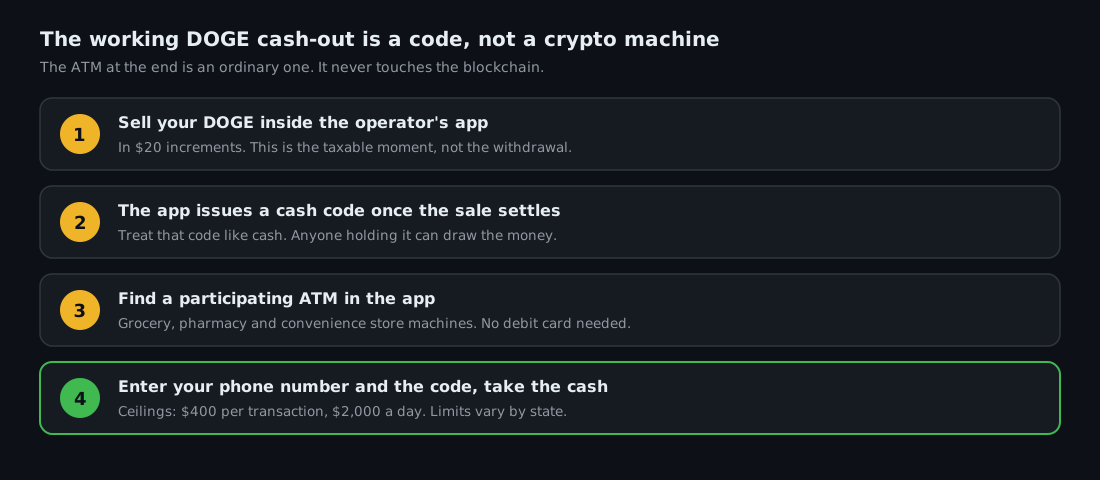
Two things to plan around. The taxable moment is the sale in the app, not the withdrawal, so the disposal is recorded the second you tap sell whether or not you ever collect the money. And that cash code behaves like cash: anyone who has it and your phone number can draw the funds, so do not read it aloud, photograph it into a shared album, or leave it on a screen in a queue.
The ceilings are the real limitation. Four hundred dollars a transaction, 2,000 dollars a day, 60,000 a month, and lower in some states. Fine for a night out. Useless for a deposit on a car, which is one reason the car buying route runs through a payment processor instead.
What it costs, and when an exchange wins
Put the numbers next to each other and the case for a machine mostly evaporates.
| Route | Cost | Roughly what you keep | Speed |
|---|---|---|---|
| Exchange sale, ACH withdrawal | ~0.80% taker, withdrawal free | ~$397 | 0 to 2 business days |
| Coinme ReadyCode cash pickup | Up to 1.99% plus $2.50 | ~$389 | Minutes, cash in hand |
| Convert to BTC, sell at a two-way kiosk | Swap spread plus ~5% | ~$370 or less | Minutes, plus a conversion |
| Buying $400 of DOGE at a Coinstar kiosk | 4% fee plus up to 18.5% spread | ~$310 of DOGE | Immediate |
The cash pickup route costs about eight dollars more than a bank transfer on 400 dollars and gets you money today. That is a defensible trade. Buying DOGE at a supermarket kiosk costs about 90 dollars on 400 and gets you nothing a phone app would not, which is not. We priced the exchange routes properly in the cash-out guide.
The ceiling is a law, not a market rate
Here is the fact that reframes every fee figure above. California decided that kiosk pricing needed a statutory limit, and the limit it chose was 15 percent.
California Financial Code section 3904, added by Senate Bill 401, states that on or after January 1, 2025, an operator cannot collect charges from a customer on a single transaction exceeding the greater of five dollars or fifteen percent of the dollar equivalent involved. A separate section, 3902, caps a kiosk at accepting or dispensing more than 1,000 dollars in a day from or to one customer.
Read that as consumer protection and it sounds reasonable. Read it as a description of the market it was written to constrain and it is damning. Legislators looked at what these machines charged and set the ceiling at fifteen percent, and operators still argued it made the business unworkable. A price that survives a 15 percent cap only barely is not a price you should be paying voluntarily in a state that has no cap.
Check your own state before you assume a posted rate is legal, and check the posted rate against the live market price on your phone before you commit either way. The markup is the part nobody advertises.
Why these machines carry a federal warning
This is the part of the topic that outweighs the fees, and it is not hypothetical.
The FBI's Internet Crime Complaint Center published state-level kiosk data on May 15, 2026. In 2025, IC3 took 13,460 complaints naming a cryptocurrency kiosk, with adjusted losses of 388,981,267 dollars. Complaints rose 23 percent on 2024 and losses rose 58 percent. More than half of those complaints came from people over 50. Texas alone accounted for 56.8 million dollars.
The FTC's numbers point the same way from a different dataset. Its September 2024 spotlight found losses at these machines rising nearly tenfold from 2020 to 2023 and topping 65 million dollars in the first half of 2024 alone, with a median reported loss of 10,000 dollars. People aged 60 and over were more than three times as likely as younger adults to report a loss at one, and more than two of every three dollars lost through these machines was lost by an older adult.
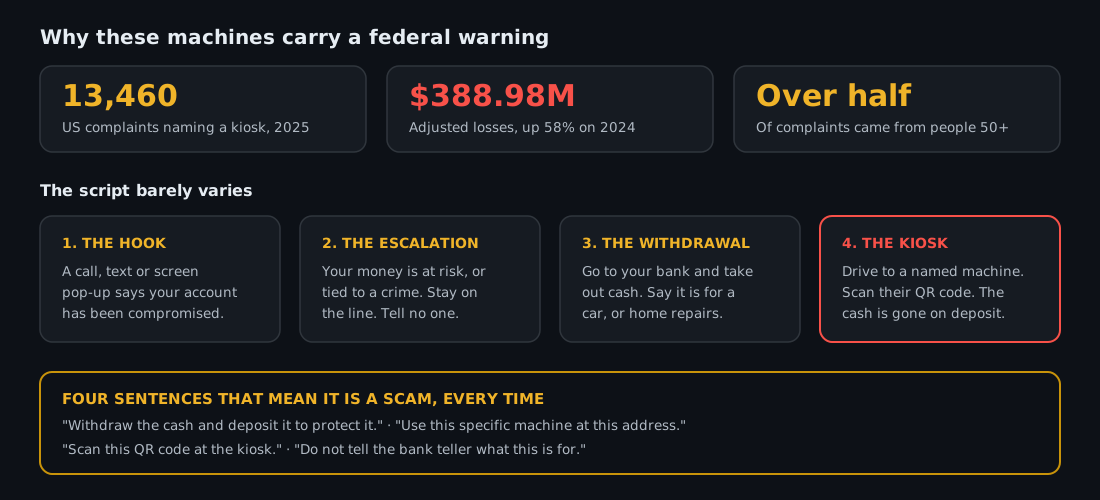
The script is remarkably consistent. A call, text or screen pop-up claims your accounts are compromised. The pressure escalates, often to a claim that your money is linked to a crime, and you are told to stay on the line and tell nobody. You are directed to your bank to withdraw cash, sometimes coached on what to tell the teller. Then you are sent to a specific machine at a specific address to scan a QR code the scammer supplies. The FBI has been describing this pattern since its November 2021 advisory, and the losses have gone up every year since.
The FTC's guidance is blunt about the tell: real businesses and government agencies never ask you to move money to protect it, so anyone who does is a scammer. The FBI adds one worth repeating. If the machine warns you about fraud on its own screen, stop. That warning exists because of exactly this.
How to find a machine that does what you need
- Decide the direction first. Buying and selling are different machines from different companies. Searching for a Dogecoin ATM when you want cash out will waste an afternoon.
- To cash out, start in the app, not the map. The Coinme app finds the ReadyCode machines, and the sale happens before you leave the house. Turning up at a machine with DOGE in a wallet and no code accomplishes nothing.
- Filter locators by coin and by direction, then confirm on the operator's own page. Directory data lags reality badly after an operator exits.
- Check the posted rate against the live price on your phone before you confirm anything. The spread is the fee that never appears as a fee.
- Bring ID. Anything meaningful requires verification, and machines advertising full anonymity are the ones the FBI specifically warns about.
Common mistakes
- Assuming a two-way machine is two-way for your coin. CoinFlip dispenses cash and does not do it for Dogecoin. That distinction has sent people on wasted drives.
- Buying DOGE at a kiosk because it is convenient. Up to 22.5 percent, for a purchase an app does for well under one percent.
- Converting DOGE to Bitcoin so you can use a machine. Two spreads for one withdrawal. Almost always worse than the cash pickup route.
- Planning a large cash-out around a machine. Four hundred dollars a transaction and 2,000 a day, and 1,000 a day at a kiosk in California by law.
- Trusting a locator listing. A quarter of the country's machines went offline in May. Confirm before you drive.
- Treating the cash code casually. It is a bearer instrument. Guard it like the notes it becomes.
- Forgetting the sale is a disposal. Selling in the app is the taxable event, whether or not you collect the cash that day.
When you do not actually need cash
Plenty of people searching for a Dogecoin ATM want to buy something rather than hold banknotes, and the machine is just the route they assumed they needed.
To spend at a specific retailer, a gift card bought with DOGE costs roughly a 2 to 4 percent spread with no queue and no limit in the hundreds. For general spending, a crypto debit card sells your coins as you swipe and works anywhere cards do, which covers most of what people withdraw cash for. And the verified merchant list covers what DOGE buys directly.
Cash is for the things that only take cash. For everything else, the machine is the most expensive answer to the question.
Related on DogeThrift: converting DOGE to dollars, buying a car with Dogecoin, subscriptions paid in DOGE, the verified merchant list.
Sources
- Bitcoin Depot Inc. Form 8-K, Item 1.03, filed May 18, 2026. Verified July 29, 2026. Voluntary Chapter 11 petitions filed May 17, 2026 by the company and sixteen affiliates in the US Bankruptcy Court for the Southern District of Texas, for an orderly wind-down and sale of assets.
- Bitcoin Depot press release, Exhibit 99.1, May 18, 2026. Verified July 29, 2026. Source of the statement that the network of kiosks has been taken offline, the 47 states and 9,000 plus locations figures, and the chief executive's comments on state transaction limits and bans.
- Coinstar cryptocurrency. Verified July 29, 2026. More than 25 cryptocurrencies including Dogecoin, 4% transaction fee, spread up to 18.5% via Coinme or up to 16.1% via Zero Hash, $3,000 daily maximum for verified customers, and the statement that there is no plan to allow selling through Coinstar kiosks.
- Coinme pricing and fees. Verified July 29, 2026. Coinstar kiosk cash exchange fee of 13.04% to 22.5%; ReadyCode cash-out fee of up to 1.99% plus $2.50 per transaction, $20 minimum, $400 per transaction, $2,000 daily, $60,000 monthly.
- Coinme cash pickup. Verified July 29, 2026. Ten supported cryptocurrencies for cash pickup with Dogecoin named, over 20,000 ReadyCode ATMs, $20 increments, and the four step redemption process.
- CoinFlip: how to sell crypto at a kiosk. Page dated as updated March 13, 2026, verified July 29, 2026. Names Bitcoin, Solana and Litecoin as sellable in the US, distinguishes buy-only from buy and sell machines, and puts selling fees generally around 5%.
- CoinFlip on Dogecoin. Verified July 29, 2026. Confirms Dogecoin is offered for purchase across the CoinFlip ATM network.
- RockItCoin FAQ. Verified July 29, 2026. Bitcoin, Ethereum, Litecoin and Bitcoin Cash. No Dogecoin. Purchases from $10 to $25,000, selling at select locations, withdrawals in multiples of 20.
- California Financial Code section 3904. Verified July 29, 2026. On or after January 1, 2025, charges may not exceed the greater of $5 or 15% of the dollar equivalent. Added by SB 401, Stats. 2023, Ch. 871.
- California Financial Code section 3902. Verified July 29, 2026. An operator may not accept or dispense more than $1,000 in a day from or to a customer via a kiosk.
- FBI IC3, cryptocurrency kiosk complaint data by state, alert I-051526-PSA, May 15, 2026. Verified July 29, 2026. 13,460 complaints and $388,981,267 in adjusted losses in 2025, complaints up 23% and losses up 58% on 2024, more than half from people over 50, Texas at $56,802,197.
- FTC Data Spotlight, Bitcoin ATMs: a payment portal for scammers, Emma Fletcher, September 3, 2024. Verified July 29, 2026. Losses up nearly tenfold from 2020 to 2023 and over $65 million in the first half of 2024, $10,000 median loss, 60 and over more than three times as likely to report a loss, more than two of every three dollars lost by older adults, and the note that these machines often handle cryptocurrencies other than Bitcoin.
- FBI IC3 advisory on cryptocurrency ATMs and QR codes, November 4, 2021. Verified July 29, 2026. Source of the irreversibility point and the guidance to stop if an operator's on-screen fraud warning appears.
- Kraken cash withdrawal options and fees. Verified July 29, 2026. Free ACH withdrawal, $1 minimum, 0 to 2 business days, used as the exchange comparison in the cost table.
- coinatmradar.com, the industry's main kiosk directory, returned HTTP 403 to automated retrieval on July 29, 2026, so no machine counts or fee averages from it are quoted here.