DogeThrift · Spending Guide
Best Crypto Debit Cards for Dogecoin Holders in 2026
This comparison was re-audited on August 7, 2026 against each issuer's own pages, and two of the three entries changed. Crypto.com now states in writing that you cannot load cryptocurrency onto its prepaid card at all. The Binance card we recommended to European readers has been dead since December 2023. That leaves the Coinbase Card as the only one of the three whose own documentation describes taking your crypto and converting it for you.
The honest short answer
Start with the question that actually separates these products: where does your DOGE turn into dollars?
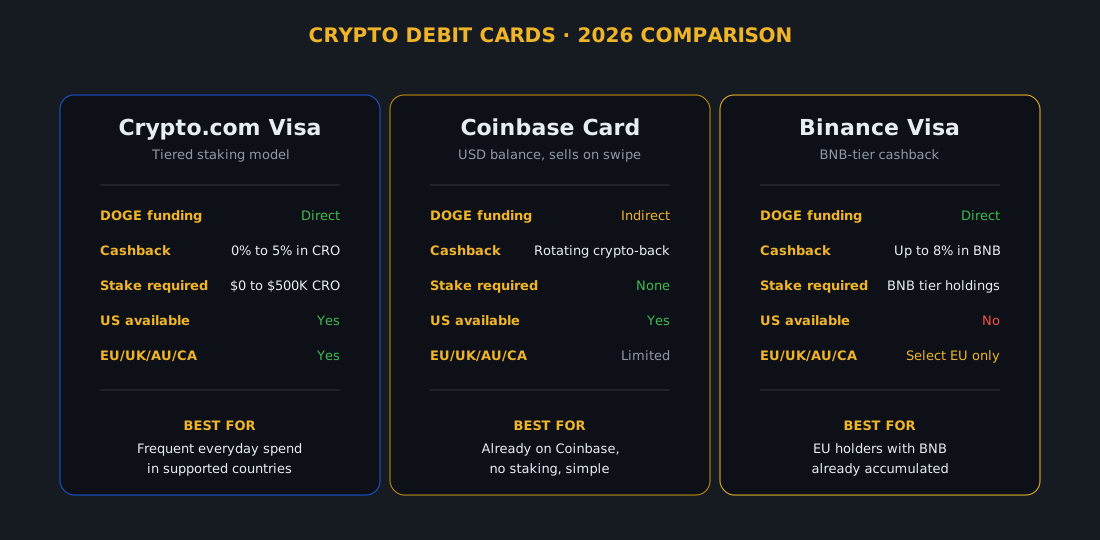
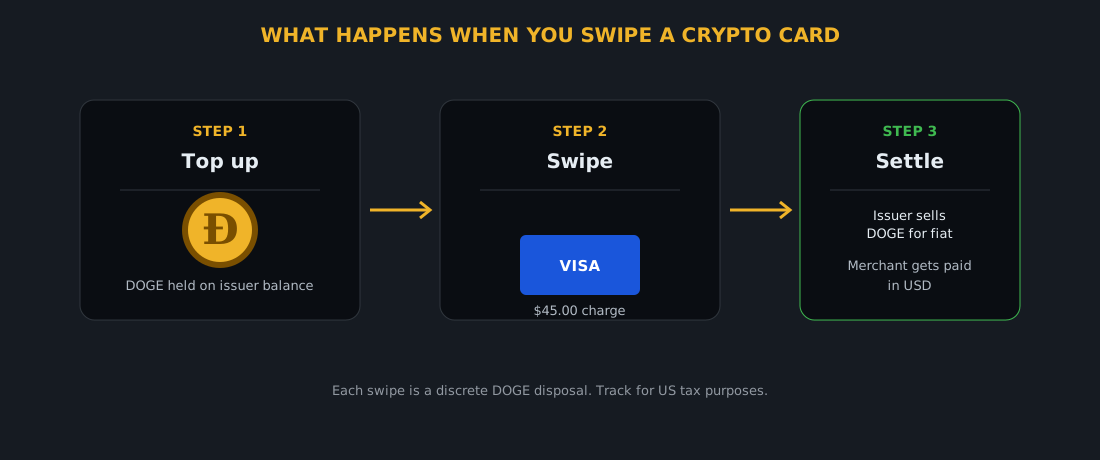
- At the swipe. The Coinbase Card. Its own page offers "spend cash or crypto" and states that Coinbase "will automatically convert all cryptocurrency to US Dollars for use in purchases and ATM withdrawals." No staking, no credit check, no subscription. US only, excluding Hawaii.
- Before the card ever sees it. The Crypto.com prepaid Visa. You sell DOGE for fiat inside the app, then load the card. Perfectly usable, but the conversion is a step you perform, which means the CRO lockup has to justify itself on rewards alone.
- Nowhere, because the card is gone. The Binance EEA Visa. Closed December 20, 2023.
If you swipe a card a couple of times a month, none of this is worth the KYC and the lockup. Buy a gift card with DOGE instead, covered in the Dogecoin gift cards guide. On August 7, 2026 that route carried a measured 5.8% premium over spot, which is worse than a card's spread but costs you nothing up front.
Rule: a rewards card pays for itself only through consistent spending. Work out your monthly volume before you lock up a token for twelve months to earn a capped 2%.
Crypto.com: two different cards now, and neither takes DOGE
The first thing to know is that crypto.com/cards no longer lands where it used to. For US visitors it now opens the Crypto.com Visa Signature credit card, a genuine credit product that pays rewards in BTC or CRO, with a Level Up tier programme and a "$0 annual credit card fees" line. The prepaid Visa this article was written about still exists, at crypto.com/us/cards/prepaidcard, and the credit-card page carries an explicit link to it: "If you prefer a prepaid card, click here for the Crypto.com Prepaid Visa Card instead."
If you followed a link here expecting the old tiered prepaid card, that is why the page looked unfamiliar.
The prepaid Visa tier table (read August 7, 2026)
| Tier | CRO rewards on everyday spend | Monthly cap | Fee or lockup |
|---|---|---|---|
| Midnight Blue | 0% | n/a | Free |
| Ruby Steel | 2% | $25 | $4.99/mo, $49.90/yr, or $500 12-month CRO staking |
| Jade Green / Royal Indigo | 3% | $75 | $29.99/mo, $299.90/yr, or $5,000 12-month CRO staking |
| Icy White / Rose Gold | 4% | No limit | $50,000 12-month CRO staking |
| Obsidian | 5% | No limit | $500,000 12-month CRO staking |
Correction, August 7, 2026: this article previously described the CRO lockup as six months. Crypto.com's current tier table says twelve. That doubles the window during which your stake is exposed to the CRO price, and it changes the break-even maths below.
The same page also sets free ATM withdrawal limits by tier, from $200 a month on Midnight Blue up to $1,000 on the top tiers, with a $10,000 monthly ATM cap and a $25,000 monthly aggregate top-up limit across every tier. Travel rewards are listed as "Coming Soon." Lounge access and the Spotify and Netflix rebates start at Jade Green and Royal Indigo.
What this means for DOGE holders, now answered plainly
In May this page could only say that Crypto.com's funding documentation was silent on DOGE. It is not silent any more, and the answer is no. From the prepaid card page itself:
"Cardholders cannot load cryptocurrency onto their Crypto.com Prepaid Visa Card. All cryptocurrency will be converted to the respective market's currency and can be loaded onto the Crypto.com Visa Card for use in purchase and ATM withdrawals."
So there is no DOGE-to-card step to hunt for on the Top Up screen. Crypto.com lists top-up sources as your Crypto Wallet, your Cash Account, or another credit or debit card, and any crypto is converted to fiat on the way through. DOGE does trade on Crypto.com, so the route works; it is just a manual sale followed by a fiat top-up, and you should count it as such when deciding whether the rewards are worth a twelve-month lockup.
The honest catches
- Rewards are paid in CRO, so their dollar value moves with the token. CRO has seen both deep drawdowns and sharp rallies since 2021. Plan for variance.
- Twelve months is a long time to be locked in. Treat the stake as capital at risk, not as money you can pull when you change your mind. The subscription alternative at $4.99 or $49.90 a year exists precisely because some people would rather pay than lock up.
- The cap bites earlier than the headline suggests. 2% capped at $25 a month means everything above roughly $1,250 of monthly spend earns nothing.
- The tier table keeps moving. It has been revised repeatedly since 2022 and the lockup length changed between our May and August checks. Read the current table yourself before committing.
Coinbase Card, the one that actually takes crypto
This is the card whose position improved most in the re-audit, because Coinbase's own page turns out to be more direct than we credited it. It leads with "Spend cash or crypto," and the fine print states plainly: "Coinbase will automatically convert all cryptocurrency to US Dollars for use in purchases and ATM withdrawals." You do not have to pre-sell into a dollar balance. Coinbase lists DOGE as a supported asset, so confirm it appears in your own spend-asset picker, then swipe.
It is a Visa debit card issued by Pathward, N.A. and available to Coinbase customers in every US state except Hawaii. Coinbase also now runs a separate credit card advertising up to 4% back in Bitcoin, which is a different product from the debit card described here.
Why pick it:
- No staking, no subscription, no credit check. Coinbase's own words: "There is no credit check or requirement to stake your assets to become eligible."
- No annual fee and no Coinbase spending fee, though a spread applies when Coinbase sells the asset. That spread is the real cost and it is not published as a number.
- Rewards you choose. A rotating list of crypto rewards, switchable at any time, at a variable rate shown in the app.
- Cleaner tax paperwork than most, since Coinbase issues 1099 forms and the sale happens on an exchange you already file against.
Why not:
- US only. Coinbase says it hopes to expand eligibility; as of August 2026 it has not.
- Every crypto swipe is a taxable sale. Coinbase states it outright: "Selling crypto using your card is a taxable transaction." Spending dollars or USDC avoids this; spending DOGE does not.
- Merchant category blocks. The card cannot be used at gambling sites, money services businesses, firearm-related businesses, cryptocurrency businesses, securities broker-dealers and several other categories.
Binance Visa: this recommendation was wrong, and had been for two years
The previous version of this article told European readers with BNB that the Binance Visa beat both other cards on cashback rate. It did not, because it did not exist. Binance closed its EEA Visa debit card programme on December 20, 2023, after Visa ended the partnership. Cards stopped working on that date. We were recommending a dead product to the exact readers who could not use it, and it took until this audit to catch, because we checked the card's marketing page rather than its support documentation.
What exists now is a "Binance Card - Global Program," whose support article was last updated on February 5, 2026. It is thin. It states that the programme "currently supports users with verified accounts in selected countries" and that "eligibility is confirmed at the time of the card application," without naming a single country. It publishes no list of assets you can fund it with. Binance's card marketing pages return nothing to an automated request, and several of its card support articles now resolve to "This article does not exist."
We are not going to characterise that as a working DOGE spending route. If you are outside the US and want to spend DOGE, the gift-card route in the gift cards guide is the one with documentation behind it. Binance also points former cardholders at Binance Pay, which is a different thing entirely: it moves crypto between Binance users and to merchants who have integrated it, not a card that works anywhere Visa does.
The US position is unchanged and was never in doubt: the global Binance card is geofenced out of the United States.

Cards we deliberately did not include
- BlockFi card. Discontinued after BlockFi's 2022 bankruptcy. If anyone tells you to get this card in 2026, they're working from stale information.
- Wirex. Has had on-and-off geographic availability and US licensing issues. We're not confident enough in its current state to recommend.
- Nexo Card. EU only, requires Nexo platform deposits. Worth a look if you're already on Nexo. If you're not, the friction isn't worth the differential.
- "Crypto rewards credit cards" from regional banks. These are not crypto debit cards. They're regular credit cards that pay rewards in BTC. Different product entirely.
The break-even math you can do at the kitchen table
Worked example, using the current numbers rather than the ones this page carried in May. Crypto.com Ruby Steel: 2% back in CRO, capped at $25 a month, for either $500 staked for twelve months or $49.90 a year.
- Spend $1,250 a month and stay under the cap: $25 a month, or $300 a year in CRO.
- Take the subscription and the sums are easy. $49.90 a year against $300 of rewards, no capital locked up, nothing exposed to the CRO price beyond the rewards themselves. That is the version most people should run.
- Take the stake and you are making a CRO bet as well as a card decision. $500 is locked for twelve months, not six. If CRO halves in that window your stake is worth $250 when it unlocks, and the $300 of rewards leaves you roughly $50 ahead of where you started. If CRO rises you do well on both. Either way you are holding a token for a year to save $49.90.
- Spend under about $1,250 a month and the rewards shrink proportionally while the lockup does not. At $400 a month you earn roughly $96 a year, and the subscription eats half of it.
- The tail risk applies to any of these. A platform failure, regulatory action or token collapse puts both the stake and unspent rewards at risk. Weigh it as you would any centralised custodian.
Run the same sum against the Coinbase Card, where the entry cost is zero and the variable is a conversion spread you cannot see in advance, and the answer for most spending patterns is that the free card wins until your volume is high and steady.
Hardware to actually receive your DOGE before topping up
Most DOGE that ends up on a crypto debit card came from a wallet you control. If your DOGE is sitting on an exchange long-term, move it to hardware before topping up the card balance. The Ledger Nano X and Trezor Safe 5 both support DOGE natively and pay direct affiliate (better than Amazon for the affiliate, plus zero counterfeit risk):
Accessories that pair well with either, available on Amazon:
- Steel seed-phrase backup capsule for fire and water-resistant seed storage.
- Longer USB-C cable than what ships in the box (Ledger and Trezor both include short ones).
- Faraday bag if you carry the wallet outside the house.
Quick decision tree
- US-based and you want your DOGE spent for you? Coinbase Card. It converts at the point of purchase, costs nothing to hold, and needs no credit check.
- US-based, high and steady monthly spend, happy to hold CRO or pay $49.90 a year? Crypto.com Ruby Steel prepaid, understanding that you convert DOGE to fiat yourself before topping up.
- US-based and you would rather have a credit card? Crypto.com's Visa Signature and Coinbase's credit card both now exist and both pay rewards in crypto. Different product, different risk, outside the scope of this comparison.
- In Europe? There is no Binance card to recommend and the Coinbase Card is US-only. Use the gift-card route.
- One-off purchases, low monthly volume? Skip cards. Buy a Bitrefill gift card with DOGE for the specific merchant.
- Hate KYC? Every card here requires full identity verification. There is no anonymous crypto card in 2026 we would put our name to.
Related on DogeThrift: spending DOGE on Amazon, gift card workarounds, the verified merchant list.
Sources
Every issuer page below was opened on August 7, 2026.
- Crypto.com Prepaid Visa Card and the international card page. Source for the quoted statement that cardholders cannot load cryptocurrency onto the card, for the full tier table, for the 12-month CRO staking terms and the subscription alternatives, and for the ATM and top-up limits.
- Crypto.com Visa Signature Credit Card. Source for the change in what
crypto.com/cardsnow shows US visitors, the Level Up tier programme, and the page's own link across to the prepaid card. - Coinbase Card. Source for "spend cash or crypto," the automatic conversion of all cryptocurrency to US dollars, US-except-Hawaii eligibility, the absence of a credit check or staking requirement, the fee position, the merchant-category exclusions, and Coinbase's own statement that spending crypto is a taxable transaction.
- Binance Card. The EEA Visa debit programme closed December 20, 2023 following Visa's withdrawal from the partnership, reported consistently in contemporaneous coverage and reflected in Binance's own support article on the EEA closure. The successor Binance Card Global Program FAQ, last updated February 5, 2026, names no countries and no fundable assets. Binance's card marketing pages returned no readable content to us.
- IRS Notice 2014-21. Cryptocurrency treated as property; spending is a taxable disposal event.
- SEC v. Binance press release (2023). Context for current Binance US restrictions.
- BlockFi (Wikipedia). Confirms the 2022 bankruptcy filing and the end of that card programme.